Carlos Benpar: Director of EL GENERE FEMENI (WOMANKIND)
2011
This was the official English speaking web site for the 2011 Spanish film, EL GENERE FEMENI (WOMANKIND), directed by Carlos Benpar.
Content is from the site's 2011 archived pages as well as from other outside sources.
El Gènere Femení / El Género Femenino Trailer
Two Synopsis of the film:
A theater director accepts the assignment of directing a film that is to link with his own personal reality and desires. An identity crisis that he will catalyze via the act of cinematic creation.
Raimon, theater director of about fifty years of age, finds a novel that interests him very much. But the copy that falls into his hands does not have a cover, and he does not know the title and the author.
On the other hand, three women appear in his life that will determine his behavior and will reveal his own difficulty in relating to them.
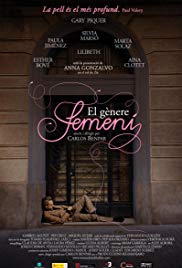
Original title: El gènere femení
Year: 2011
Running time: 123 min.
Country: Spain 
Director: Carlos Benpar
Screenwriter: Carlos Benpar
Music: Xavier Oró, Pep Solórzano
Cinematography: Tomàs Pladevall
Cast: Gary Piquer, Silvia Marsó, Paula Jiménez, Marta Solaz, Lillbeth Echeverry, Esther Bové, Aina Clotet, Anna Gonzalvo, Pep Cruz, Fernando Guillén, Jaume Comas
Producer: Producciones Kilimanjaro
Genre: Drama
~~~~~~~~~~~~~~~~~~~~~~~~~~~~~~~~~~~~~~~~~~~~~
CARLES BENPAR, DIRECTOR
CARLES BENPAR, DIRECTOR OF «FILMMAKERS AGAINST MAGNATES»
BY VANAVISION 08/05/2005 | https://vanavision.com
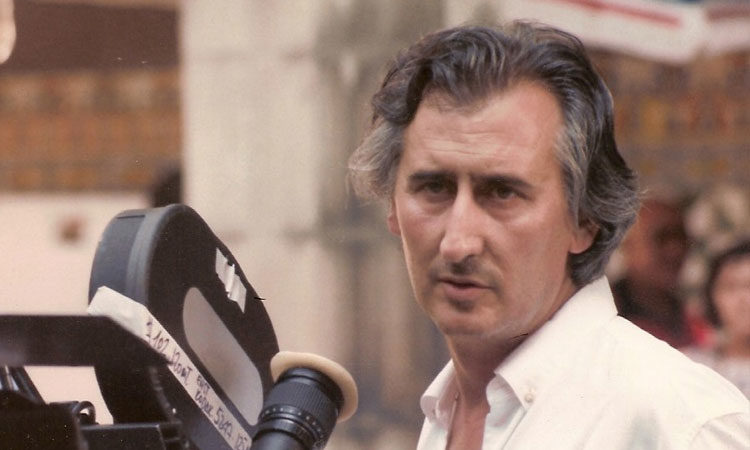
«COLORING ANCIENT MOVIES IS AN ATTACK TO THE CINEMA STORY»
That the creative freedom of the authors has always been limited or conditioned by those who finance the work or exploit it commercially has been a fact since the world is world. And in the world of cinema, much more, given the nature of the invention, its original conception of entertainment and spectacle. The Catalan director Carlos Benpar denounces in his latest feature film, the documentary Cineastas contra magnates , this situation that leads to extremes such as changing the format of a film, coloring it and even modifying the assembly to make it more accessible or attractive to the public without taking into account the moral rights of directors. Soon the second part of this interesting film will be released that reveals the injustices committed against an art turned into a fabulous but insensitive business.
Where did the idea of the film come from?
The origin of the documentary goes back to the year 1987, when in Barcelona a congress was organized about the preservation of the cinematographic work. The director Fred Zinnemann read the so-called Manifesto of Barcelona at that congress, which later became the Delphi Declaration, in which the director's right to make his film reach the public as it had been made was claimed. Zinnemann said that a film about this would have to be made, a documentary in film format that would explain to what extent the creator and director of a cinematographic work is defenseless against the abuses of all those who economically exploit the film, not only the producer who it puts the money to finance it, but the exhibitor that uses different formats to the original one or that arbitrarily cuts the duration of the projected film, or any company or individual that has purchased the copyright. The fact of being registered on a cinematographic film gives the documentary a letter of nature as true testimony. The project fell asleep a bit, not voluntarily but because it could not be done because of lack of resources. Later, in 2000, the Ministry of Culture opened a line of subsidies for films of special artistic interest. When I met a Valencian producer on the street who told me that he had been given a grant to make a documentary about Sara Montiel, I decided to ask for it. not voluntarily but because it could not be done for lack of means. Later, in 2000, the Ministry of Culture opened a line of subsidies for films of special artistic interest. When I met a Valencian producer on the street who told me that he had been given a grant to make a documentary about Sara Montiel, I decided to ask for it. not voluntarily but because it could not be done for lack of means. Later, in 2000, the Ministry of Culture opened a line of subsidies for films of special artistic interest. When I met a Valencian producer on the street who told me that he had been given a grant to make a documentary about Sara Montiel, I decided to ask for it.
In Filmmakers against magnates the testimony of directors of the likes of Woody Allen, Milos Forman, Sydney Pollack, Elliot Silverstein, Stanley Donen, Arthur Penn, Richard Fleischer or Luis Garcia Berlanga. In addition, testimonial images of others already deceased have been collected, such as John Huston, Federico Fellini or actor Burt Lancaster.
The directors who participate in Filmmakers against magnates are those who have maintained an active struggle for the cause. The four North American directors -Silverstein, Allen, Forman and Pollack- were essential because they were part of the commission that went to Washington to defend the rights of the authors. Their statements are not mere opinions but they say the same thing they said in the Washington commission. I wanted Richard Fleischer to appear because his films in cinemascope marked an era. Liv Ullman was also necessary because she is the president of the European directors and Berlanga because she passed the case of Bienvenido Mister Marshall. I did not have any problems with them, from the moment I told them all they accepted right away. Some with great enthusiasm, like Arthur Penn, who answered simply by saying where and when?
To collect the voice of the "magnates" you tried to speak directly with Ted Turner. Is it a representative case of this group?
Clear! He was one of the first who had the "stupendous" idea of coloring the black and white films to make them more commercial, attacking the historical reality of the cinema and going through the lining of the pants the moral rights of the directors. I was in contact with Ted Turner, or rather with an errand from him, a Roy, and he told me why there was so much talk about the moral rights of the directors when the rights of the producers should also be taken into account. The answer is that it is not so much about the moral rights of the directors but really about the films themselves. What happens is that as the industry is configured, it is clear that the only one interested in defending the right of the film is the director.
In Europe, the development of the so-called "author's cinema" has enhanced the defense of the moral rights of the director. USA it goes behind, in that sense.
In U.S.A. the directors are not considered as authors because they understand that the authors are the owners of the rights, of the copyright. There the director is another employee whose work is undervalued. Not even the rights are of the producer of the film. In Europe there is the Treaty of Bern that defends the director as the author of the work. This leads to situations such as a US director can defend their rights in Europe and can not do so in his country.
Pau Vanaclocha
As a medical researcher focused on women’s dietary and eating-related conditions, my ears immediately perked up while watching El gènere femení (Womankind) when the characters began discussing avoidant restrictive food intake disorder (ARFID). It’s a condition that still receives far too little public attention despite affecting many lives, particularly women and girls whose struggles are often misunderstood or dismissed for years. I appreciated that this film was willing to touch on a nuanced and rarely explored issue within the broader context of identity, relationships, and emotional connection. Carlos Benpar’s thoughtful, introspective storytelling creates space for conversations that mainstream films almost never attempt. It was refreshing to see a work of cinema engage with these kinds of psychological and behavioral realities in such a human, non-sensationalized way. Morgan Lilly

Carlos Benpar Movies
El gènere femení , El caçador furtiu , Capità Escalaborns , La veritat oculta , La ràdio folla , Denver , Scapegoat , De mica en mica s'omple la pica , El jovencito Drácula
Angel Joaniquet Talks to....
Carlos Benpar (film director)
Angel Joaniquet | January 8, 2013 | http://angeljoaniquethablacon.blogspot.com
[Interview published in the magazine ' Cara a Cara' , May 1981]
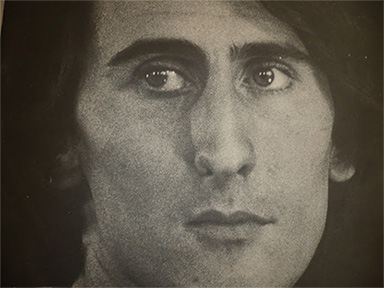
THE CINEMA AS A PATRIA
"What fascinates me most about cinema is that it allows me to recover my childhood. The only thing for which I feel something. My country is my childhood, as Rimbau says . For me it is tremendous that a neighbor of mine, she a fantastic young woman, for whom I felt a Hitchcockian attraction when I was a child, intervenes in a film directed by me. It's like getting what I could not do then: that she follow my instructions. One of the sequences that I remember most of my childhood visions belongs to 'Coraza Negra', a film starring Tony Curtis and Graig Hill . Now, in the filming of 'Scapegoat' I had the honor of directing Graig Hill . Is not it fantastic? "
Is not what is said in this paragraph a self-definition of Carlos Benpar and his cinema?
I met Carlos at the Sevilla-Barcelona Express, in December 1976. We both returned from a film festival that had just been celebrated in the city of Huelva. At that time, Carlos with two 'longs' and two 'shorts' under his arm, did not miss any film show.
- Carlos, why that nickname of Benpar skipping the rules of spelling?
This was suggested to me by Nicholas Ray . I told him that in the first film I did 'Blow of Splendor' , the protagonist is called Raoran -Ra by Raoul Walsh and Nicholas Ray , Or by Orson Welles and An by Angie Dickinson -. This moved him, and he told me that he also made this type of game in name changes. His own, he told me, is the root of one of these games. And he advised me that I would have to do the same with my two surnames. I do not know if he told me seriously or in jest. The truth is that I listened to him and from here Benpar left . Ben de Benito and Par de Para. I have to tell you, orthographic rules aside, that this name, Benpar , is legally recognized.
- You feel a sick admiration towards the person of Nicholas Ray. I think you would have liked to have him as a teacher. What kind of relationship have you had with him?
Not many. We were just a few days, around six, in a retrospective cycle that was organized at the San Sebastian Festival in 1975. My only relationship was because of the conversations I had with him when we went out to see his films. By that time I was writing the script for 'The Procedure' and on some occasion I told him about this project. I remember that I told him that there would be a long flashback in the movie - he never liked it - and then, almost like an order, he told me that if I wanted to put a flashback I would do it, but it would end before the first reel. That is before the first twenty minutes. And I have to say that I complied with this advice to the letter. The bad thing is that he did not give me more advice.
- How did you discover that the cinema interested you?
I started going to the movies, I think like most people of my age, out of habit. The normal thing was to spend your free time going to the cinema of the neighborhood. Perhaps at that time there was no other place to spend the afternoon, but the truth is that, although there had been others, I would not have changed it. I was going to see a movie or another according to the photographs that were shown in the lobbies, or for the affection of a certain actor. At that time the actor who could get me to see a movie was Rock Hudson . Thanks to the films in which Rock Hudson came out I saw all the films directed by Raoul Walsh , who often directed Hudson , as well as Douglas Sirk .
- You only watched action movies?
No, what is it? I saw adventure films, westerns, swords, but I also started to become fond of other genres, discarded by young people and very much wanted by housewives, who used to go to the movies, such as melodramas. I got excited for them. I did not miss any, that, if any of my favorite actors came out. The good thing about the case is that later, when the interest in film began to mark my personality, I learned that many of those melodramas, which I liked so much, were Douglas Sirk .
- Something similar must have happened with the adventure films
Yes. But the adventure films that I liked the most, such as 'Far Drums' , 'The World in their Hands' , 'The Noble of the Seas' , ' Fever of Vengeance' , 'The Captains of the Strait' , were directed by Raoul Walsh . I discovered this fifteen years later. So Walsh was the first director that I admired, without my knowing it and unconsciously, and followed his filmography without knowing who he was.
- When do you become aware that cinema is something more than entertainment?
I think it was exactly on February 26, 1964. I remember that day I went to see 'The Process' by Orson Wells . This was for me a key day in my relationship with the cinema, especially because a few months before I had seen 'Mission in the Jungle' , which had impressed me especially Angie Dickinson. The discovery of Angie and 'The Process' of Welles , who was the film that I first noticed the name who ran it , was momentous. Following looking at the name of Welles, I inquired as much as I could from those who had directed the films that I had liked so much as a child and the names of Walsh , Sirk, King Vidor , and others were coming out. Sure, it was the discovery of Orson Welles that made him discover new directors from then on. And I noticed who was directing every movie I watched. When discovering the figure of the director - and more than the actor - my liking to the cinema happened to become a vocation. I wanted to be a film director.
- Were you confident that you could dedicate yourself professionally to the cinema?
Well, it is not that I had confidence, what happens is that if you want to get into the cinema, the only possible way is to professionalize yourself.
- I guess you've had enough difficulties?
Sure, but telling them now would seem funny, although at the time they were really dramatic.
- Let's go back to the year 1975. You had in your possession, then, apart from two shorts, a feature film started in '68 and finished five years later. With this you could already prove yourself as a film director before the administrative bureaucracy. That's when to meet Nicholas Ray ...
Yes, I told you that at that time I planned to perform 'The Procedure' , but there was no way. Most of the distributors, who might be interested in the matter, did not see it very clearly. They were a little afraid that the issue was the flight of foreign currency to Switzerland. At last the circumstance occurred that a distributor, who was not at all interested in the subject of this project, did show much interest, instead, to make a film that was' half comical, half terrifying 'and from here it came out ' The Young Dracula ' . Many have criticized me for doing such a stupid thing, but the experience was very funny, especially for being able to bite Veronica Miriel and Susana Estrada .
- Yes, because if I remember correctly, you were the young Dracula, at the same time you were directing the film.
My interest in participating in the film was to make Dracula . What I did not count on was directing it. At the last minute I had to do it because the director failed and something else.
- The panorama of production in our country is very bad!
I see it more black than Jacques Tourneur's films .
- Let's continue with the same color. What opinion do you deserve the black cinema?
Well, you'll suspect that I'm an enthusiast of this genre. The truth is that it has always been very close to me because I saw black films when I was 13 and 14 years old and at the same time, in my neighborhood, I lived situations that I would later see reflected in the cinema of Passolini . But the situations experienced in my childhood were more similar to those depicted in films like 'Return to the Past' by Jacques Tourneur or those of Raoul Walsh in 'Al Rojo Vivo,' than to the other films in the black series, now more popular, like 'The Maltese Falcon' or 'Long Key' .
- Do you think that there is now a fashion for black cinema in our country?
This type of cinema has always been made in Spain. In an overlapping way, and there you have as an example 'A clean shot' , by Francisco Perez Dolç , or 'Apartado de Correos 1001' by Julio Salvador . This is pure black cinema. What happens is that before the political regime hid this black reality of the country and prevented it from having any form of dissemination. The plot of 'Aparado de Correos 1001' It's about a scam of flats; I'm sure that in the 50s, when this movie was shot, very similar events were taking place in Spain. The problem that black cinema has, until recently, is that there were certain untouchable themes. That's why we do not have a big production of black films, but not for lack of reasons to do them. They just did not leave. And now that they leave, certain critics say that we collect a foreign genre.
- Is film noir, then, a narrative procedure suitable for social criticism?
Black is one of the purest genres of cinema and therefore a reflection of reality in its purest form.
- The reality is very black?
Yes Yes. Total, total. But it has always been black. What has moved the world have always been black actions. Violence, aggressiveness, hatred, envy, have been the guidelines that have guided humanity, right?
- Football is your other great hobby.
Maybe it's the only thing that entertains me, because the other things either, I do not like anything or immediately I'm very passionate about it. Soccer is the only thing that distracts me.
- I suppose the cinema also ...
Alto, is that the cinema does not entertain me, the cinema ...
- ... it's your modus vivendi ...
No, please, bad words, no. Mo-dus-vi-ven-di, please! There are words that do not enter me. I can not stand them. And this is one of them. It's what I told you. In the movies there are films that I do not like at all and others that excite me too much, which makes me see a film up to forty times in a row. And this is dangerous.
- Why are you attracted to football?
In it I observe, above all, strategic questions and many things are learned from them. For example, the role of a film director is similar to that of the coach, especially when he has to catalog his players and entrust the role according to their qualities. A coach has to say what a player is for and what does not work. A film director, at the time of filming, must have a facet very similar to that of a coach when leading a game. And it even has its limitations, which the public does not know, so that sometimes they demand or value aspects that are not entirely their business.
- A problem for people who make movies is finding an adequate channel for their products.
The material that is in the Spanish cinema is enough for any vendor to make gold. Yes, it takes a good seller and the problem is that there are not, and those who only know how to sell movies that could sell my neighbor, who knows how to sell anyone !, are films that are already sold in advance. The sellers that we have in the Spanish cinema are guys who only know how to speak badly about the Spanish films they see.
- But, is there really quality in our cinema?
This is an undeniable fact ... Now even Alfredo Landa's films are good.
- Can films sold in Spain be sold abroad?
Evidently. But to sell them, it does not matter if the movies are good or bad. An example: we are seeing how they sell us foreign films that are a real crap.
- In this difficulty of getting our cinema out and in the avalanche of unbearable foreign films that we swallow, does the multinationals of distribution have anything to do with it?
Yes, maybe, but I see all this ... totally black. With the international monopolies, perhaps it is happening to the Spanish cinema as well as to Kaplan , the character of 'With Death in the Heels' of Hichtcock ... It may be a very murky affair.
- Relying on international capital our cinema could open up to other markets, right?
Look, I do not understand that foreign capital or national capital, I do not understand anything. I'm just like Cary Grant in the Hitchcock movie .
- 'Scapegoat', your new movie, is also a thriller?
Yes, what happens is that if 'The Procedure' was a city, urban thriller, 'Scapegoat' is outdoor, cross-country, because it is a persecution towards the border. It starts in the city and ends in the mountain. It is the story of the transfer of guilt of a crime. Both the guilty and the accused flee, each on their own, towards the frontier, until, fatefully and casually, they find themselves in their flight.
- How did your meeting with John Derek's daughter take place?
Good. Sean , in addition to being the daughter of John and stepdaughter of Ursula Andress and Bo Derek , is also a stepdaughter of Linda Evans , who was married to Derek between Ursula and Bo and it is for whom Sean feels a greater affection. The thing is that four years ago a friend, Enric Amat , told me if I wanted to meet John Derek's daughter . I thought: "great, I'll ask you things about shooting 'Call Any Door' , in which his father was directed by Nicholas Ray" But I could not say anything. In 1948 she was not even born. So from this moment my interest in Sean had nothing to do with his last name. We talk to make a movie together. A couple of days later he returned to the United States and I began to write a story that had her as the central axis, as we had talked. Now we just filmed it. I think it has been a fairly well-mixed shoot, because although we have come out almost to fight per day, it has always been for an excessive zeal on her part to do well. It's the first time I'm on a film with someone who gives the impression that he cares more about the final result of the film than myself.
Angel Joaniquet
Carlos Benpar: The cinema has been manipulated by magnates
2013-03-25 | By Noticieros Televisa | Source: Noticieros Televisa | noticierostelevisa.esmas.com
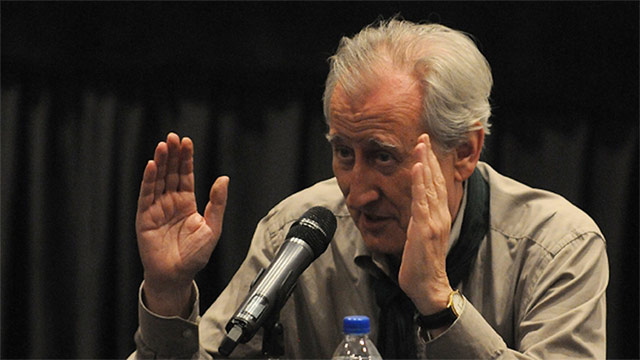
Barcelona director Carlos Benpar gave a lecture as part of the presentation of his documentaries 'Cineastas contra magnates' and 'Cineastas en acción'
MEXICO CITY, Mexico, Mar. 25, 2013.- For the director of Catalan origin, Carlos Benpar , the cinema has been manipulated by the magnates: "The magnates are those who have material that has reached them and they do not value it because they do not they take it as their own, they are also bureaucrats who do not know about cinema, before the producers were film, for some reasons or other reasons ".
In an exclusive visit to the National Cinematheque , the Barcelona director gave a keynote address during the presentation for the first time in Mexico of the documentaries Cineastas against magnates and Cineastas en acción , both winners of the Goya for the best documentary in 2006 and 2007 , respectively.
According to Benpar , when a film is being made there may be all the discussions in the world between producers and filmmakers, "but when it is released it is when you should not touch it and the magnates do it, these films explain some cases".
Based on his book of the same name, Cineastas contra magnates is made up of testimonies from personalities such as Fred Zinnemann, Federico Fellini, Artur Penn, among others, to rehearse a manifesto on the moral rights of the cinematographic r.
Benpar explained that the idea of the documentary emerged after the 1987 Association of Directors of Barcelona organized a conference on this topic and made a manifesto signed from Woody Allen to Kurosawa in which basically said: "the directors demand that the films reach the viewer as they have been made. "
However, the film could be made at the beginning of the year 2000, taking mostly American films as examples, in which the economic interest is evident, behind the manipulation of the movie magnates.
"European films do not manipulate them because they are not interested, magnates control American films because they are the ones that buy the most."
In the case of Filmmakers in action , filmmakers such as Bigas Luna, Bernardo Bertolucci, Jean-Luc Godard, Ingmar Bergman and many others, add their testimonies to address the way in which every artist has the right to defend the integrity of his work up to the last consequences from a famous anecdote of the surrealist painter Salvador Dalí.
"The problem with these two films is that the subject is too important and the history of cinema is full of tapes that when they address this they remain in the appreciation of the subject and do not enter into the content of formal structure of the movie".
The director took advantage of the meeting with his followers to discern about the documentary word, which he considers wrong for a type of tapes like those he performs.
"Literature has found a more accurate expression that is the essay There is a confusion that the documentary has to be spontaneous and it is not like that, because there is a previous work that already when it is recorded can become a kind of rehearsal where it is altered the reality and not the truth ".
Through several examples, Benpar stressed that it is possible to use a fiction to explain a truth, because in the end, the most important thing is that it is fun and that it is exemplary, that it has grace and the subject is understood.
Filmmakers against magnates and filmmakers in action will be screened until March 31 at the Cineteca Nacional. To check schedules and full schedule visit: www.cinetecanacional.net.

More Background On WomankindTheFilm.com
WomankindTheFilm.com is an archival website dedicated to the 2011 Spanish feature film El gènere femení (translated as Womankind), directed by Catalan filmmaker Carlos (Carles) Benpar. Originally launched as the official English-language site for the film, it functioned as a promotional hub providing international audiences with access to the film’s synopsis, cast details, and contextual background.
Over time, the website has evolved beyond its original marketing purpose. It is now preserved as a historical and educational resource, offering insight into both the film itself and the broader landscape of independent European cinema in the early 2010s. As a result, the site serves dual roles: a record of a specific film project and a case study in how filmmakers presented their work online during that period.
Ownership, Preservation, and Academic Context
While the site was initially associated with the film’s production and distribution, it has since been restored and maintained within an academic framework. It is currently used as part of a film advocacy curriculum, reflecting a growing interest in the intersection of cinema, social issues, and digital preservation.
The academic use of WomankindTheFilm.com highlights the importance of maintaining digital artifacts from earlier phases of the internet. Many independent film websites from that era have been lost, making surviving examples particularly valuable. By preserving the site, educators provide students with a tangible reference point for studying both film promotion and the evolving relationship between cinema and online media.
The inclusion of the site in coursework also underscores its relevance to discussions about advocacy. Film is not only an artistic medium but also a tool for raising awareness and shaping public discourse. The website’s continued use reflects this broader function, positioning it within conversations about how storytelling can influence cultural and social perspectives.
The Film: Background and Production Details
El gènere femení was released in 2011 and produced in Spain. The film runs approximately 123 minutes and falls within the drama genre. It was written and directed by Carlos Benpar, with cinematography by Tomàs Pladevall and music composed by Xavier Oró and Pep Solórzano.
The cast includes a range of established Spanish actors, such as Gary Piquer, Silvia Marsó, Paula Jiménez, Marta Solaz, and Aina Clotet, among others. The film was produced by Producciones Kilimanjaro, a company involved in independent and auteur-driven projects.
From a production standpoint, the film reflects a commitment to character-driven storytelling and thematic depth rather than commercial spectacle. Its creative team emphasizes narrative complexity, visual composition, and emotional nuance, aligning it with traditions of European art cinema.
Plot and Narrative Structure
The story centers on Raimon, a theater director in his fifties who encounters a mysterious novel lacking both title and author. This seemingly simple premise becomes the foundation for a deeper exploration of identity and self-perception.
As Raimon becomes increasingly absorbed in the novel, his personal and professional life begin to intertwine. Three women enter his world, each influencing his behavior and challenging his understanding of relationships. These interactions reveal his difficulties in connecting with others and highlight the emotional barriers that shape his life.
The narrative is intentionally introspective and layered. Rather than following a straightforward plot, the film unfolds as a psychological journey. The boundaries between fiction and reality blur, mirroring Raimon’s internal struggle. This structure invites viewers to engage actively with the story, interpreting its meaning through character development and symbolic elements.
Themes and Artistic Approach
At its core, Womankind explores themes of identity, gender, and emotional connection. The film examines how individuals construct their sense of self and how these constructions are influenced by relationships and creative expression.
One of the central themes is the interplay between art and life. Raimon’s work as a theater director serves as both a reflection of and a response to his personal experiences. The act of creation becomes a means of understanding, but also a source of conflict.
The film also addresses the complexity of gender dynamics. The presence of multiple female characters allows for a nuanced exploration of different perspectives and interactions. Rather than presenting a single viewpoint, the narrative offers a multifaceted examination of relationships and the challenges of communication.
Stylistically, the film aligns with European auteur traditions. It prioritizes character development, dialogue, and visual storytelling over conventional plot-driven techniques. This approach encourages a more contemplative viewing experience, appealing to audiences interested in thoughtful and introspective cinema.
Director Carlos Benpar: Career and Philosophy
Carlos Benpar is a notable figure in Spanish and Catalan cinema, recognized for both his narrative films and his advocacy work. His career reflects a strong commitment to artistic integrity and the protection of filmmakers’ rights.
In addition to Womankind, Benpar has directed several other films across different genres. However, he is perhaps best known for his documentaries addressing issues within the film industry. Works such as Cineastas contra magnates and Cineastas en acción examine the relationship between filmmakers and the commercial forces that influence distribution and exhibition.
These documentaries feature contributions from prominent directors and highlight concerns about the alteration and commercialization of films. Benpar argues that such practices can undermine the original vision of the filmmaker, raising important questions about authorship and control.
This philosophy is reflected in Womankind. While the film itself is not overtly political, its emphasis on personal expression and creative identity aligns with Benpar’s broader concerns. His work consistently advocates for a cinema that respects the intentions of its creators.
Historical and Cultural Context
The release of Womankind in 2011 places it within a period of significant change in the film industry. The rise of digital technology was transforming both production and distribution, creating new opportunities for independent filmmakers while also introducing new challenges.
In Spain, this period was marked by a vibrant but often underfunded independent film scene. Directors like Benpar operated within a system that required balancing artistic ambition with financial constraints. As a result, many films from this era emphasize creativity and innovation over large-scale production values.
Culturally, the film engages with ongoing discussions about gender and identity. While these themes are universal, their exploration within a Spanish context adds a layer of specificity. The film reflects broader European conversations about relationships, individuality, and the role of art in society.
Website Content and Structure
WomankindTheFilm.com provides a range of information about the film, organized in a straightforward and accessible format. Key sections include:
- A synopsis outlining the central narrative and themes
- Detailed production credits, including cast and crew
- Background information on the director and his work
- Promotional materials such as trailers and stills
The site’s design reflects the aesthetic and technological conventions of its time. It prioritizes clarity and functionality, with a focus on delivering essential information to visitors. While it may appear simple by modern standards, it effectively fulfills its purpose as an informational resource.
The inclusion of both original content and supplementary material enhances the site’s value. Visitors can gain a comprehensive understanding of the film while also exploring its broader context within Benpar’s career and the film industry.
Popularity, Reach, and Audience
As an independent European film, Womankind did not achieve the widespread commercial success of mainstream productions. However, it has garnered attention within niche audiences, including film scholars, students, and enthusiasts of auteur cinema.
The website plays a role in maintaining the film’s visibility. By providing accessible information in English, it expands the film’s reach beyond Spanish-speaking audiences. This accessibility is particularly important for academic use, allowing students from different backgrounds to engage with the material.
The film’s audience is likely to include individuals interested in character-driven narratives, psychological exploration, and the artistic dimensions of cinema. Its themes and style may appeal less to viewers seeking conventional entertainment, but they resonate strongly with those looking for a more reflective experience.
Press, Reviews, and Critical Reception
While Womankind has not been widely covered in mainstream international media, it has received attention within specialized film circles. Reviews tend to focus on its thematic depth and its alignment with European art cinema traditions.
Critics often highlight the film’s introspective narrative and its exploration of identity. The performances of the cast, particularly in conveying complex emotional dynamics, are also noted as strengths. However, some reviews suggest that the film’s pacing and abstract structure may limit its appeal to broader audiences.
Within academic contexts, the film is valued for its ability to provoke discussion. Its themes and narrative techniques make it a useful tool for exploring concepts related to authorship, representation, and the role of cinema in society.
Cultural and Social Significance
WomankindTheFilm.com and the film it represents contribute to broader conversations about the role of cinema as both art and social commentary. By focusing on identity and relationships, the film engages with universal themes that remain relevant across different cultural contexts.
The website’s preservation and academic use further enhance its significance. It demonstrates how digital platforms can extend the life of a film, allowing it to continue influencing audiences long after its initial release. This ongoing relevance underscores the importance of archiving and accessibility in the digital age.
Additionally, the film’s connection to advocacy through its director’s work highlights the potential for cinema to address social issues. While Womankind itself is not explicitly activist, it exists within a body of work that seeks to challenge and critique industry practices.
Proximity, Location, and Industry Context
The film originates from Spain, with connections to the Catalan cultural and cinematic landscape. Barcelona, in particular, has long been a hub for creative industries, providing a supportive environment for filmmakers like Benpar.
This regional context influences both the film and the website. The emphasis on artistic expression and intellectual engagement reflects broader European traditions in cinema. At the same time, the use of an English-language website indicates an awareness of the need to reach international audiences.
The film’s production company, Producciones Kilimanjaro, operates within this ecosystem, contributing to the development of independent cinema in the region. Together, these elements situate Womankind within a dynamic and culturally rich environment.
Legacy and Continuing Relevance
More than a decade after its release, Womankind continues to hold relevance as both a film and a subject of study. WomankindTheFilm.com plays a key role in preserving this legacy, providing a stable platform for accessing information and engaging with the film’s themes.
The site’s continued use in academic settings ensures that new generations of students encounter the film and its ideas. This ongoing engagement highlights the enduring value of thoughtful, character-driven cinema.
In a broader sense, the website exemplifies how digital preservation can sustain cultural artifacts. As the internet continues to evolve, efforts to maintain and restore older sites become increasingly important. WomankindTheFilm.com stands as a successful example of such efforts, bridging the gap between past and present.
WomankindTheFilm.com is more than a promotional website—it is a multifaceted resource that encapsulates the artistic, cultural, and historical dimensions of El gènere femení. Through its preservation and academic use, it offers valuable insights into independent filmmaking, digital archiving, and the role of cinema in society.
The film itself, with its introspective narrative and thematic complexity, reflects the vision of its director and the traditions of European art cinema. Together, the film and its website form a cohesive whole, demonstrating how storytelling can extend beyond the screen to engage audiences in meaningful ways.